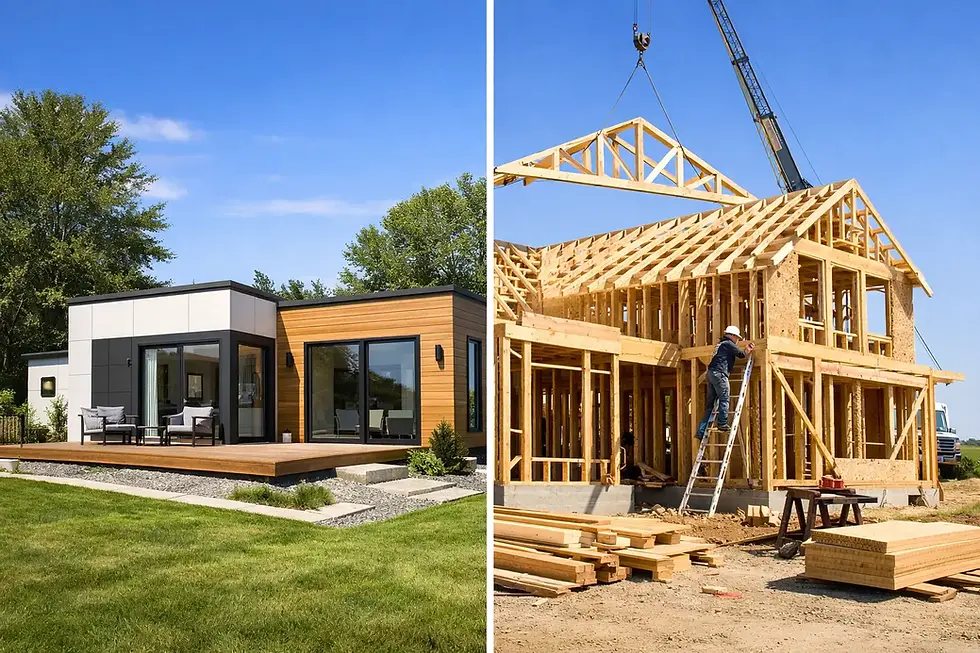
How Factory Built Homes Work
- StratCan Building Systems
- 4 hours ago
- 5 min read

A factory-built home does not start with a truck pulling into your lot. It starts much earlier - with engineering, code review, production planning, and a controlled build process designed to reduce delays and improve consistency. For buyers comparing building methods, understanding how factory built homes work helps separate practical advantages from common assumptions.
The short version is this: major sections of the home are built indoors in a manufacturing facility, then shipped to the site for installation and final completion. That sounds simple, but the real value is in how the process controls labor, materials, inspections, and scheduling before the home ever reaches your land.
How factory built homes work from design to delivery
The process usually begins with selecting a home model and customizing it to fit the buyer's needs, budget, and property conditions. Floor plans, exterior finishes, roof design, window placement, mechanical options, and interior selections are typically decided before production begins. This is also the stage where code requirements, structural needs, and transportation constraints are reviewed.
Unlike a conventional site-built project, the home is then manufactured in a plant under controlled conditions. Walls, floors, roof systems, insulation, windows, doors, cabinetry, and many interior finishes may be installed before shipment. Because the work happens indoors, production is less exposed to weather delays, material damage, and the scheduling problems that often affect trades on open job sites.
Once the home sections are complete, they are prepared for transport, delivered to the property, and placed on the foundation using cranes or specialized setting equipment. After that, crews complete the final work on site. That may include joining sections together, connecting utilities, finishing exterior tie-ins, completing roofing details, and carrying out final inspections required for occupancy.
What gets built in the factory and what happens on site
One of the biggest misconceptions is that everything is finished at the factory. In practice, it depends on the home design, transport limits, and site conditions.
A large portion of the structural shell and interior work is commonly completed in the factory. That often includes framing, insulation, vapor barriers, windows, doors, drywall, cabinets, plumbing rough-ins, electrical rough-ins, and a significant amount of interior finish work. The benefit is quality control. Materials are measured, cut, and assembled in a repeatable environment with established production standards.
Site work still matters. The land must be prepared, access must be suitable for delivery, and the foundation must be installed to the correct specifications before the home arrives. Utility hookups, grading, steps, decks, skirting, garages, and some finishing details are typically handled after delivery. If the lot is remote, sloped, narrow, or difficult to access, those conditions can affect both cost and timing.
That balance is important for buyers to understand. Factory-built does not mean zero site work. It means a larger share of the construction happens earlier, under tighter controls, before installation day.
Design, engineering, and certification
Before production starts, the home must be engineered for applicable building requirements. In Canada, certification and code compliance are a major part of the buying decision because they affect financing, insurance, and permitting. A properly certified factory-built home is not an improvised shortcut. It is a regulated building product designed to meet recognized standards.
This is where reputable suppliers stand apart. Buyers should expect clarity on certification, structural design, and what standards the home is built to. That matters even more in regions where wind, snow load, moisture, and transportation logistics place extra demands on the structure.
Transportation shapes the design
Homes built in sections must be designed to move safely from the plant to the site. Width, height, road access, escort requirements, and lifting points all influence the final plan. That does not eliminate customization, but it does introduce practical limits.
For example, an open-concept layout may need structural solutions that allow sections to be joined on site. Roof pitches, porch details, and certain exterior features may be completed after delivery instead of during factory production. None of that is a problem when accounted for early. It becomes a problem when buyers assume every site-built detail translates directly without adjustment.
Why factory-built homes often move faster
Speed is one of the main reasons buyers consider this route, but it helps to be precise about where the time savings come from.
The factory can build the home while site preparation is happening in parallel. Instead of waiting for each stage to happen one after another on the same property, foundation work, permitting steps, and manufacturing can overlap. The controlled environment also reduces weather-related slowdowns during framing and interior assembly.
That said, faster does not mean instant. Delivery scheduling, permit approval, utility coordination, crane availability, and site readiness still control the final timeline. If the lot is not ready when the home is complete, the project can still be delayed. A well-managed factory-built project is faster because more of the process is planned in advance, not because the on-site requirements disappear.
Cost structure and where the value comes from
Factory-built homes are often chosen for cost predictability as much as speed. Controlled production tends to reduce waste, improve labor efficiency, and limit surprise costs tied to weather exposure or inconsistent trade scheduling.
That does not mean every factory-built home is cheaper than every site-built home. Pricing depends on the design, finish level, transportation distance, site complexity, foundation type, and local installation costs. A simple lot with good road access is very different from a remote property that needs extensive groundwork and utility extension.
The real advantage is usually budget control. Buyers can often define the home specifications earlier, receive clearer pricing, and make fewer in-process changes that increase costs later. For many property owners, that level of certainty is just as valuable as the base price itself.
Trade-offs buyers should understand
Factory-built homes solve many common construction problems, but they are not the right fit for every project.
The process works best when decisions are made early and the buyer is comfortable locking in design choices before production starts. Late changes can be more difficult than they would be on an open site build. Transportation also introduces design constraints that may affect dimensions or certain architectural features.
Site conditions matter more than some buyers expect. If access roads are tight, grades are steep, or crane setup is limited, delivery and placement may require extra planning and cost. In some cases, a highly customized home on a difficult site may be better suited to another construction method.
That is why the supplier's role matters. A dependable project partner will explain not only the benefits, but also the constraints, approvals, and responsibilities that affect the final outcome.
How to evaluate a factory-built home supplier
If you are comparing options, focus less on marketing language and more on process discipline. Ask how the home is engineered, what certifications apply, how customization is handled, what is included in the quoted scope, and what site work remains the buyer's responsibility.
You should also ask about delivery coordination, local code familiarity, and whether the supplier understands the conditions your home will face after installation. In regions with demanding weather and transportation realities, that experience is not a minor detail. It has a direct effect on durability, scheduling, and total project risk.
A supplier such as StratCan Building Systems adds value by helping buyers connect certified factory-built products with local project requirements, practical site planning, and a clearer path to delivery.
A practical way to think about the process
The best way to understand factory-built housing is to stop thinking of it as a product arriving fully finished and start thinking of it as a construction method with more control built into the front end. The home is still designed, engineered, transported, installed, inspected, and completed through a sequence of real construction steps. The difference is where those steps happen and how tightly they are managed.
For buyers who want a code-compliant home, a more predictable timeline, and fewer variables during construction, that control can make a meaningful difference. The right next step is not guessing from photos or assumptions. It is reviewing your land, your budget, your design priorities, and your access conditions with a supplier who can tell you what will work before the first section is ever built.